Curaçao Population Pyramid 2071
Year
2071Curaçao in 2071
By 2071, the population of Curaçao is expected to reach 154,136. Ten years before, in 2061, the projected population is still 163,597 — a ten-year decline of 5.8%.
With a projected median age of 53.4 years, Curaçao would have a youth dependency ratio of 17.4 and an old-age dependency ratio of 57.8 per 100 people of working age. This is a constrictive pyramid — its base is narrower than its middle, the signature of sustained low birth rates and population ageing.
Data source: United Nations World Population Prospects, 2024 revision (medium variant) — last updated July 2024.
The fertility rate of Curaçao was 1.20 births per woman in 2023, under the 2.1 needed to replace each generation.
Source: World Bank World Development Indicators, latest available year.
Life expectancy at birth was 76.8 years in 2023: 80.8 for women and 72.5 for men.
Source: World Bank World Development Indicators, latest available year.
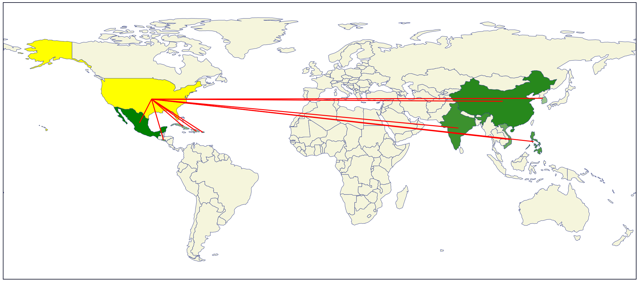
73,756 immigrants live in Curaçao, 39.8% of the population.
| Venezuela | 23,078 |
| Netherlands | 14,772 |
| Dominican Republic | 9,322 |
| Colombia | 7,075 |
| Haiti | 3,210 |
8,518 people born in Curaçao live in other countries.
| Aruba | 3,764 |
| Netherlands | 3,159 |
| Venezuela | 646 |
| United States Virgin Islands | 278 |
| Bolivia | 207 |
Source: United Nations International Migrant Stock 2024.
| Country | Population | Median age | Relative size |
|---|---|---|---|
| Curaçao | 154,136 | 53.4 | |
| Saint Lucia | 147,011 | 50.7 | |
| Grenada | 99,874 | 51.8 | |
| Aruba | 88,806 | 48.4 | |
| Antigua and Barbuda | 85,301 | 50.7 |