Micronesia Population Pyramid 2071

Micronesia
2071
Population: 641,295

Year

-5 -1   2071  +1 +5

Country

A B C D E F G H I J K L M N O P Q R S T U V W Y Z
Embed this population pyramid ×

Copy the code below and paste it into your website or LMS.

Micronesia in 2071

United Nations projections (medium variant) put the population of Micronesia at 641,295 in 2071. That would be 2.7% more than in 2061 (624,608).

Half of the population would be younger than 36.2 years, with 20.4% children under 15 and 14.5% aged 65 or older. This is a stationary pyramid — similar numbers in each age group up to the older cohorts, the signature of near-replacement fertility.

Share of the population by age group, 1950–2100

Data source: United Nations World Population Prospects, 2024 revision (medium variant) — last updated July 2024.

Population
641,295
Median age
36.2
0-14 %
20.4%
65+ %
14.5%
Child dependency
31.3
Old-age dependency
22.3
Pyramid shape
Births per woman

The World Bank does not publish this indicator for regions or continents.

Life expectancy at birth

The World Bank does not publish this indicator for regions or continents.

People supported per 100 workers
Dependency ratios, 1950–2100
Children Older adults
22456890
19502100
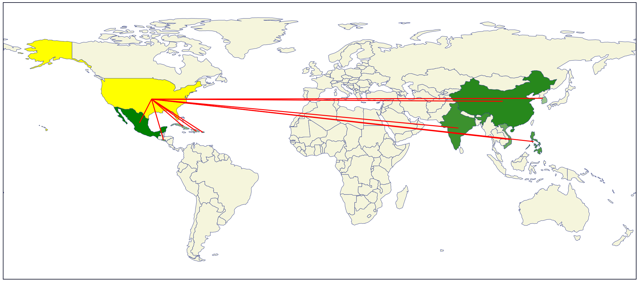
Where immigrants come from (2024)

108,001 immigrants live in Micronesia.

Philippines47,488
United States of America23,747
Micronesia (Fed. States of)13,567
China6,094
Puerto Rico5,292
Where emigrants live (2024)

25,113 people born in Micronesia live in other countries.

Guam16,074
New Zealand3,015
Australia2,508
Kiribati1,675
Fiji808
Explore
Immigration statistics

Source: United Nations International Migrant Stock 2024.

How many people are projected to live in Micronesia in 2071?
Micronesia is projected to have a population of 641,295 in 2071.
How old is the population of Micronesia?
Micronesia's median age is 36.2 years.
How many children and older people live in Micronesia?
14.5% of Micronesia's population is 65 or older, and 20.4% is under 15.
What shape is Micronesia's population pyramid, and what does it mean?
Micronesia's pyramid is stationary — similar-sized cohorts through the younger ages, the signature of near-replacement fertility.

Check our other visualizations