Papua New Guinea Population Pyramid 2071
Papua New Guinea in 2071
United Nations projections (medium variant) put the population of Papua New Guinea at 17,270,186 in 2071. Compared with 2061, when the projection stands at 16,296,837, that represents growth of 6.0% over ten years.
The median age is projected at 33.5 years, with 33.3 children under 15 and 16.0 people aged 65 or over for every 100 people of working age (15–64). This is a stationary pyramid — similar numbers in each age group up to the older cohorts, the signature of near-replacement fertility.
Data source: United Nations World Population Prospects, 2024 revision (medium variant) — last updated July 2024.
In 2023 women in Papua New Guinea had on average 3.10 children, above the replacement level of 2.1.
Source: World Bank World Development Indicators, latest available year.
Life expectancy at birth was 66.1 years in 2023: 69.1 for women and 63.7 for men.
Source: World Bank World Development Indicators, latest available year.
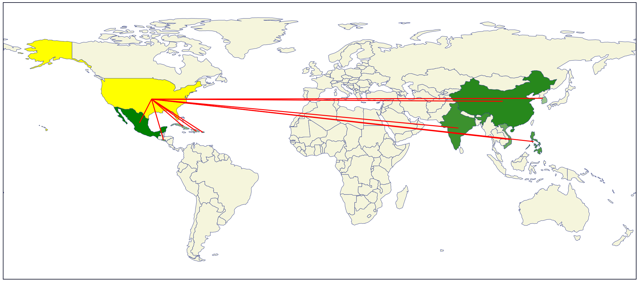
30,035 immigrants live in Papua New Guinea, 0.3% of the population.
| Indonesia | 13,638 |
| Australia | 9,250 |
| New Zealand | 1,789 |
| United Kingdom | 1,626 |
| Philippines | 1,468 |
35,031 people born in Papua New Guinea live in other countries.
| Australia | 34,316 |
| Solomon Islands | 538 |
| Vanuatu | 69 |
| Samoa | 34 |
| Guinea | 14 |
Source: United Nations International Migrant Stock 2024.
| Country | Population | Median age | Relative size |
|---|---|---|---|
| Papua New Guinea | 17,270,186 | 33.5 | |
| Solomon Islands | 1,616,469 | 32.4 | |
| Fiji | 980,921 | 38.5 | |
| Vanuatu | 699,514 | 30.6 | |
| New Caledonia | 347,380 | 45.0 |