Russian Federation Population Pyramid 2071
Russian Federation in 2071
United Nations projections (medium variant) put the population of the Russian Federation at 129,431,946 in 2071. Ten years before, in 2061, the projected population is still 132,551,964 — a ten-year decline of 2.4%.
Half of the population would be younger than 44.8 years, with 14.3% children under 15 and 23.6% aged 65 or older. This is a constrictive pyramid — its base is narrower than its middle, the signature of sustained low birth rates and population ageing.
Data source: United Nations World Population Prospects, 2024 revision (medium variant) — last updated July 2024.
In 2023 women in the Russian Federation had on average 1.41 children, below the replacement level of 2.1.
Source: World Bank World Development Indicators, latest available year.
Life expectancy at birth was 73.3 years in 2023: 78.7 for women and 68.0 for men.
Source: World Bank World Development Indicators, latest available year.
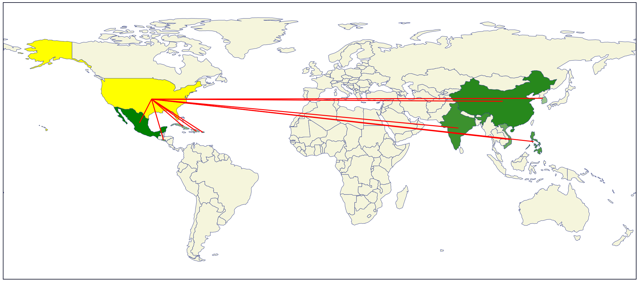
7,270,597 immigrants live in Russian Federation, 5.0% of the population.
| Ukraine | 2,872,612 |
| Kazakhstan | 1,321,004 |
| Uzbekistan | 778,041 |
| Tajikistan | 415,676 |
| Armenia | 340,512 |
9,133,942 people born in Russian Federation live in other countries.
| Ukraine | 3,375,095 |
| Germany | 1,137,448 |
| Uzbekistan | 865,767 |
| Belarus | 664,610 |
| Kazakhstan | 552,258 |
Source: United Nations International Migrant Stock 2024.
| Country | Population | Median age | Relative size |
|---|---|---|---|
| Russian Federation | 129,431,946 | 44.8 | |
| Poland | 26,788,405 | 55.5 | |
| Ukraine | 24,231,503 | 57.5 | |
| Romania | 13,390,697 | 48.8 | |
| Czech Republic | 8,929,610 | 48.4 |