United States Virgin Islands Population Pyramid 2071
United States Virgin Islands in 2071
United Nations projections (medium variant) put the population of the United States Virgin Islands at 65,916 in 2071. Compared with 2061, when the projection stands at 67,714, that represents a decline of 2.7% over ten years.
Half of the population would be younger than 44.4 years, with 15.8% children under 15 and 24.2% aged 65 or older. This is a constrictive pyramid — its base is narrower than its middle, the signature of sustained low birth rates and population ageing.
Data source: United Nations World Population Prospects, 2024 revision (medium variant) — last updated July 2024.
In 2023 women in the United States Virgin Islands had on average 1.98 children, below the replacement level of 2.1.
Source: World Bank World Development Indicators, latest available year.
Life expectancy at birth was 80.5 years in 2023: 83.9 for women and 77.3 for men.
Source: World Bank World Development Indicators, latest available year.
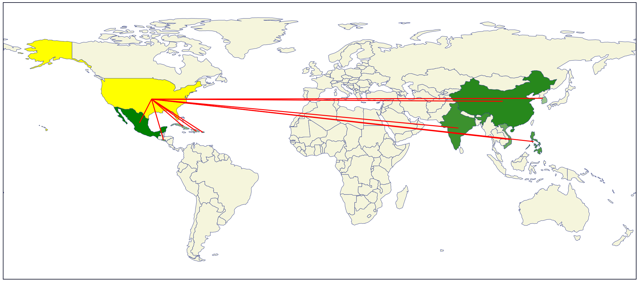
38,650 immigrants live in United States Virgin Islands, 45.5% of the population.
| United States of America | 16,895 |
| Dominican Republic | 4,644 |
| Antigua and Barbuda | 4,590 |
| Puerto Rico | 4,069 |
| Saint Lucia | 3,427 |
2,881 people born in United States Virgin Islands live in other countries.
| Antigua and Barbuda | 770 |
| Grenada | 670 |
| Mali | 606 |
| Colombia | 276 |
| Puerto Rico | 231 |
Source: United Nations International Migrant Stock 2024.
| Country | Population | Median age | Relative size |
|---|---|---|---|
| United States Virgin Islands | 65,916 | 44.4 | |
| Saint Vincent and the Grenadines | 78,455 | 45.6 | |
| Antigua and Barbuda | 85,301 | 50.7 | |
| Aruba | 88,806 | 48.4 | |
| Grenada | 99,874 | 51.8 |